

Medical Diagnostics & Imaging for Auto Injuries
Faster diagnosis means faster treatment and recovery. Our MRI, CT, ultrasound, fluoroscopy, and X-ray are all on-site, so your scan, results, and treatment plan happen under one roof.
- On-site imaging
- No outside referral
- Board-certified radiologists
- 1.5 TeslaWide-bore MRI
- 128-sliceCT scanner
- On-siteMRI, CT, X-ray, ultrasound & fluoroscopy
- $0Upfront cost when another driver caused it
Our diagnostic capabilities
MRI
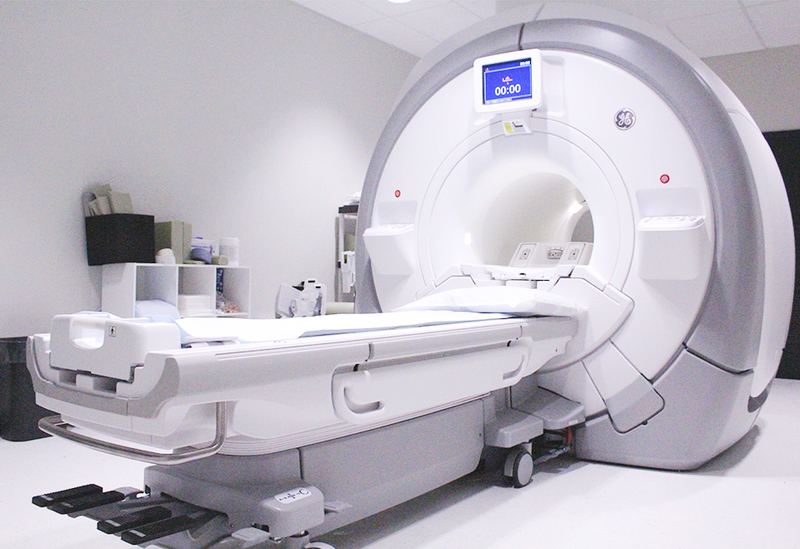
GE Signa 450W short wide bore 1.5 Tesla scanner.
Hospital-level image quality to detect hidden injuries from auto accidents, including soft tissue damage, disc injuries, ligament tears, and subtle spinal changes that may not show up on X-rays alone. Uses a strong magnet and radio waves, not ionizing radiation.
Learn moreCT scan
Siemens SOMATOM go.Top 128-slice CT.
Captures extremely thin X-ray “slices” in a single rotation, then stitches them into detailed 3D views so doctors can quickly identify fractures, internal bleeding, organ injuries, and other trauma.
Learn moreUltrasound
Canon Aplio a550 ultrasound system.
Non-invasive and radiation-free. Lets our doctors watch structures move in real time to spot muscle, tendon, ligament, and organ injuries.
Learn moreX-ray
Immediate high-resolution imaging of your bones.
Identifies and characterizes fractures, which are common in auto accidents. Some are complex, others subtle and easy to miss without proper imaging.
Learn moreFluoroscopy
Two GE 9800 C-arm fluoroscopy systems.
Real-time, moving X-ray imaging. Lets our doctors see the spine and joints in motion and precisely guide injections.
Learn moreNerve testing
EMG and nerve conduction velocity studies.
Assess nerve and muscle function when numbness, tingling, or weakness points to nerve involvement.
Learn moreFunctional & lab tests
Range of motion, strength, and neurological testing.
Documents your injury and progress. When needed, we may also order laboratory blood panels or other lab tests to reach a complete diagnosis.
Learn more
Stop stressing over your MRI
If just thinking about an MRI makes you claustrophobic, our GE Signa 450W is designed to make the experience much more comfortable.
- Shorter, wider openingInstead of a long, tight tunnel, more space around your head and body eases that “closed in” feeling.
- Room for every bodyMany people who struggle to fit in older scanners can have their MRI here without feeling squeezed.
- Calmer for kids and anxious patientsThe more open feel helps people who are already nervous about medical tests.
- Sharper imagesAdvanced sequences, including fat suppression, give clear, high-resolution images of your spine, joints, brain, and soft tissues.
From exam to diagnosis, all under one roof
- 1
Physician evaluation determines what to image
A licensed MD performs a focused musculoskeletal and neurological exam, then orders only the imaging your clinical presentation requires, no unnecessary scans.
- 2
Imaging performed on-site
Digital X-ray, MRI, CT, ultrasound, or fluoroscopy are performed in our facility. X-rays are usually done the same day; MRI and fluoroscopy are scheduled as a separate appointment. No outside imaging center to coordinate with.
- 3
Board-certified radiologist reads your images
Images are interpreted by board-certified radiologists, and your doctor goes over the results with you at your next appointment, usually within a week.
- 4
Physician reviews findings with you
At your next appointment, usually within a week, your MD reviews the images and radiology report with you, explains what was found, and answers questions.
- 5
Diagnosis with ICD-10 coding
A written diagnosis including ICD-10 codes is issued the same day, required for your insurance claim.
- 6
Treatment begins same day when appropriate
Physical therapy, pain management, or medication can often begin right away, and your plan is updated once imaging results are in.
How long each study takes
| Study | Time |
|---|---|
| X-ray | About 10 minutes |
| Cervical or lumbar MRI | 30–45 minutes |
| CT scan | 10–15 minutes |
| Ultrasound | 15–30 minutes |
Insurance covers your imaging.
When another driver caused the accident, their insurance covers medically necessary X-ray, MRI, CT, ultrasound, and fluoroscopy. Auto accident patients usually do not need pre-authorization.
Need imaging after a crash? Get scanned and diagnosed today.
What to do if you’ve been in an auto accident
At the scene
- Stay calm, make sure everyone is ok, and move to safety if you are able. If anyone needs immediate medical attention, call 911.
- Do not drive away from the scene unless told to do so by law enforcement.
- Call the police to file an accident report. Never apologize or admit guilt.
Before you leave
- Take pictures on your phone or camera.
- Exchange information with the other driver and file an insurance claim.
Then see a doctor
- Call (405) 842-3209 to see a medical doctor.
- On your first visit we take your medical history and give you a physical exam.
- If more tests are needed to pinpoint your injury, you can visit our on-site imaging lab.
Frequently asked questions about medical imaging
What imaging is available at Accident Care?
We perform digital X-ray, MRI, CT scan, diagnostic ultrasound, and fluoroscopy all on-site at our Oklahoma City clinic. No outside referral is needed, and every modality is in-house. X-rays are usually done the same day; MRI and fluoroscopy are scheduled as a separate appointment.
Can I get an MRI at Accident Care?
Yes. Accident Care has its own MRI on-site, so there is no outside imaging center to deal with. MRI is scheduled as its own appointment here, and your doctor reviews the results with you at your next appointment, usually within a week.
Do I need pre-authorization from my auto insurance?
Typically no. Auto accident injury patients usually do not need pre-authorization for medically necessary imaging. Accident Care orders and performs imaging based on your physician’s clinical judgment.
Will insurance cover my imaging after a car accident?
Yes. When another driver caused the accident, their insurance covers medically necessary X-ray, MRI, CT, ultrasound, and fluoroscopy. Zero upfront out-of-pocket cost to you.
What is the difference between a high-field and low-field MRI?
High-field MRI (1.5 Tesla or greater) produces sharper images of soft tissue and discs. Low-field or open MRI trades image quality for patient comfort. For accident injury diagnosis, high-field MRI detects disc and soft-tissue detail that low-field units miss.
Is X-ray enough to diagnose whiplash or soft-tissue injury?
No. X-ray shows bone and alignment only. Whiplash, disc herniation, and most soft-tissue injuries are not visible on X-ray. MRI is the gold standard for diagnosing these injuries.
How long does each imaging study take?
X-ray takes about 10 minutes. Cervical or lumbar MRI takes 30–45 minutes. CT scan takes 10–15 minutes. Ultrasound takes 15–30 minutes. Your doctor reviews the results with you at your next appointment, usually within a week.
Do I need a referral for imaging at Accident Care?
No outside referral is needed. Accident Care’s physicians evaluate you, determine what imaging is medically necessary, order the study, and perform it here in our facility, with no outside imaging center.
Get the answers you need, all in one place.
Same day appointments available. Walk-ins welcome. No upfront out-of-pocket cost.