

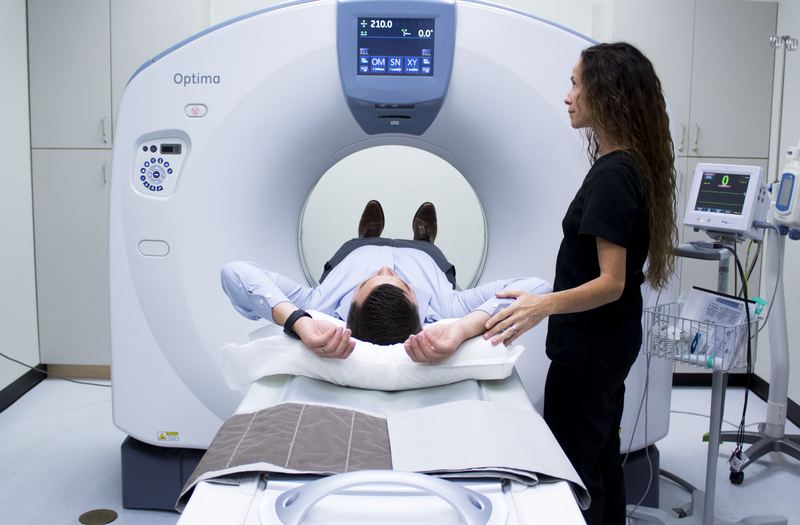
CT Scan After a Car Accident: 128-Slice Imaging in Oklahoma City
Our Siemens SOMATOM go.Top 128-slice CT scanner builds sub-millimeter cross-sections of your body in seconds, then turns them into 3D views. It is the test of choice for complex fractures and bony injury, and it is on-site at Accident Care, ordered by your physician.
- 128 slices per rotation
- Sub-millimeter detail
- 3D reconstructions
- 128Slices per rotation
- < 1 mmSlice thickness for reformats
- 10–15 minTypical time on the table
- SecondsActual scan time
Why CT matters after a crash
What is a CT scan?
A CT (computed tomography) scan rotates an X-ray tube and detector around you and measures how much each tissue absorbs from hundreds of angles. A computer reconstructs thin cross-sectional slices that can be viewed in any plane or as a 3D model. After a car accident, CT is the most accurate test for fractures, dislocations, and other bony injuries, and it is the preferred first test for the cervical spine in adults who meet criteria for imaging after trauma.
A plain X-ray flattens a three-dimensional body onto one image, so overlapping bones can hide a fracture. CT removes that overlap. Each slice shows a thin section of anatomy on its own, which is why CT finds fractures of the vertebrae, facets, pelvis, wrist, and foot that X-rays miss.
Accident Care’s scanner is a Siemens SOMATOM go.Top with a 64-row detector that acquires 128 slices per rotation. Your Accident Care physician orders CT when the exam or X-ray raises concern for a fracture, when bony anatomy needs to be mapped in detail, or when MRI is not possible. Board-certified radiologists read every study, and your doctor goes over the results with you at your next appointment, usually within a week.
How CT works
An X-ray tube and an opposing curved detector spin around you inside the gantry while the table moves through it. This helical (spiral) acquisition collects a continuous volume of data rather than separate pictures.
At each angle the detector measures how much of the beam each path through your body absorbed (attenuation). Reconstruction algorithms, including iterative reconstruction, convert those thousands of measurements into a grid of tiny volume elements (voxels), each with its own density value.
Those values are expressed in Hounsfield units (HU): water is 0, air is −1000, fat is about −100, soft tissue is roughly +20 to +80, acute blood is about +50 to +70, and dense cortical bone is +1000 or higher. The radiologist “windows” the image, choosing which HU range maps to the gray scale, to look at bone, soft tissue, or lung in turn.
Because the voxels are nearly the same size in every direction, thin axial slices can be rebuilt as sagittal and coronal images (multiplanar reformats) or as 3D volume renderings. That is how a radiologist follows a fracture line through a vertebra or shows a surgeon exactly how a joint surface is displaced.
Dose is shaped at the source. Automatic exposure control adjusts the beam to your body size slice by slice, and the go.Top platform uses Siemens’ tin filter technology to remove low-energy photons that add dose without adding diagnostic information.
Radiation dose in context
| Exam or exposure | Typical effective dose |
|---|---|
| Natural background radiation (one year, U.S.) | About 3 mSv |
| Chest X-ray | About 0.1 mSv |
| Lumbar spine X-ray series | About 1.4 mSv |
| CT head | About 2 mSv |
| CT spine | About 6 mSv |
What CT finds after a car accident
Spine fractures
Vertebral body, facet, lamina, and transverse process fractures.
CT shows compression and burst fractures, posterior element fractures, and fractures at the craniocervical junction such as the odontoid (C2). Reformats show how much the spinal canal is narrowed.
Occult and complex fractures
Wrist, foot, pelvis, ribs, sternum, and joint surfaces.
Scaphoid, calcaneus, tibial plateau, and acetabular fractures are easy to miss on plain films. CT defines fragment position and whether a joint surface is involved.
Alignment and dislocation
Subluxations, facet jumps, and joint incongruity.
Thin-slice reformats show small step-offs between vertebrae and perched or locked facets after flexion-distraction injuries.
Head and facial injury
Skull and facial fractures and intracranial blood.
Acute blood is bright on non-contrast CT. CT is the first test when head injury criteria are met, while MRI is more sensitive for subtle brain injury.
3D surgical planning
Volume renderings for complex injuries.
3D models help orthopedic and spine surgeons plan fixation when a fracture needs a surgical opinion.
When MRI is not possible
Patients with non-MR-safe implants.
When a pacemaker or other device rules out MRI, CT (sometimes with CT myelography at a hospital) can answer key questions about the canal and foramina.
Who actually needs a CT after a crash?
Not every crash patient needs CT, and good clinics don’t scan by reflex. Validated decision rules help physicians decide. The NEXUS criteria and the Canadian C-Spine Rule identify patients at low risk of cervical spine injury who can safely skip imaging, based on factors like midline tenderness, focal neurological deficit, intoxication, distracting injury, age, dangerous mechanism, and the ability to rotate the neck 45 degrees each way.
When imaging of the neck is indicated in an adult after blunt trauma, the American College of Radiology recommends CT rather than plain X-rays, because CT is substantially more sensitive for fractures. For head injury, the Canadian CT Head Rule plays a similar role.
CT has a blind spot: ligaments, discs, and the spinal cord are poorly seen. A normal CT does not rule out a ligament injury or disc herniation. If symptoms such as radiating pain, numbness, or weakness persist, your physician may follow up with MRI.
Hurt in a car accident? See a medical doctor. No outside imaging center, no upfront out-of-pocket cost.
What CT scan can and can’t do
Strengths
- Most accurate routine test for fractures and bony detail
- Very fast: the scan itself takes seconds, which helps patients in pain
- Any-plane reformats and 3D models from one acquisition
- Works when MRI is unsafe because of an implant
Limits
- Uses ionizing radiation, so it is ordered only when medically necessary
- Limited view of discs, ligaments, nerves, and the spinal cord
- Metal hardware can cause streak artifact
- If iodinated contrast is used, allergy and kidney function must be checked first
CT safety
- Tell us if you are or may be pregnant before any CT.
- Dose is kept as low as reasonably achievable (ALARA) with automatic exposure control and size-based protocols.
- Most CTs for accident injuries are non-contrast. If contrast is needed, you will be asked about allergies, kidney disease, diabetes medications such as metformin, and prior contrast reactions.
- Remove jewelry and metal from the area being scanned.
Step by step at Accident Care
- 1
Your physician orders the study
CT is ordered when your exam or X-ray suggests a fracture or bony injury, or when MRI isn’t an option for you.
- 2
Scheduling
Your scan is done here in our facility, with no outside referral. Your care team will tell you when it is scheduled.
- 3
Positioning
You lie on the table, which moves through a short, open ring (the gantry). It is not an enclosed tube.
- 4
The scan
You hold still, sometimes holding your breath for a few seconds. The scan itself takes seconds; total table time is usually 10 to 15 minutes.
- 5
Reconstruction and radiologist read
The images are rebuilt into thin slices, reformats, and 3D views, and a board-certified radiologist issues a written report.
- 6
Results with your doctor
Your doctor reviews the results with you at your next appointment, usually within a week.
CT scan after a car accident: common questions
What is the difference between a CT scan and an MRI?
CT uses X-rays and is best for bone, fractures, and acute bleeding. It is very fast. MRI uses a magnetic field and radio waves and is best for soft tissue: discs, ligaments, nerves, muscles, and the spinal cord. After a car accident, CT answers “is anything broken?” and MRI answers “what soft tissue is injured?”
What does “128-slice” mean?
It describes how many thin cross-sections the scanner captures in each rotation of the X-ray tube. Our Siemens SOMATOM go.Top uses a 64-row detector that acquires 128 slices per rotation, which allows fast scans with sub-millimeter detail and smooth 3D reconstructions.
How much radiation is in a CT scan?
A CT of the head is about 2 mSv and a CT of the spine about 6 mSv, compared with roughly 3 mSv of natural background radiation each year in the U.S. Your physician orders CT only when the information it provides is worth that dose, and the scanner adjusts dose to your body size.
Can a CT scan miss an injury?
CT is excellent for bone but can miss soft-tissue injuries such as disc herniations, ligament tears, and nerve compression. A normal CT does not mean you are not hurt. If symptoms continue, your physician may order MRI.
Do I need contrast for a CT after a car accident?
Usually not. Fractures and bony injuries are evaluated without contrast. Contrast is used for specific questions, and you will be screened for allergies and kidney function first.
Is CT safe during pregnancy?
CT of areas away from the abdomen and pelvis delivers very little dose to a fetus, but always tell us if you are or might be pregnant. Your physician will weigh the risks and consider alternatives such as MRI or ultrasound.
Does insurance cover a CT scan after a car accident?
When another driver caused the accident, their insurance covers medically necessary imaging, including CT. Accident Care bills the insurance directly, so there is zero upfront out-of-pocket cost to you.
How long does a CT scan take?
The scan itself takes seconds. Total time on the table, including positioning, is usually 10 to 15 minutes.
Is a CT scanner an enclosed tube like an MRI?
No. The CT gantry is a short, open ring. The table moves you through it, and most of your body stays outside the ring, so claustrophobia is rarely a problem.
Will a CT scan show a herniated disc?
CT can sometimes suggest a large disc herniation, but it shows discs, nerves, and ligaments poorly. MRI is the test for disc and nerve root problems.
Can a CT scan detect a concussion?
CT detects skull fractures and bleeding in or around the brain. It is usually normal after a concussion, which is a clinical diagnosis. A normal head CT rules out a dangerous bleed, not a concussion.
My X-ray was normal. Why would I need a CT?
X-rays overlap anatomy and can miss fractures, especially in the spine, wrist, foot, and pelvis. CT is far more sensitive, so it is ordered when your exam still suggests a fracture despite a normal X-ray.
Can I have a CT if I have metal implants?
Yes. Metal is not a safety issue for CT, though it can cause streaks on the images near the implant. Technologists use protocols that reduce this artifact.
Do I need to fast before a CT scan?
Not for a non-contrast CT, which is what most accident injuries need. If contrast is required, you will receive specific instructions.
When will I get my CT results?
A board-certified radiologist reads the study and issues a written report, and your doctor reviews the results with you at your next appointment, usually within a week.
Do I need a referral for a CT scan at Accident Care?
No outside referral is needed. Your Accident Care physician orders the scan, and it is done here in our facility.
Other diagnostic tools at Accident Care
MRI
How our on-site GE 1.5 Tesla wide-bore MRI finds disc herniations, ligament tears, bone bruises and nerve compression after a crash.
Learn moreUltrasound
How our on-site Canon Aplio a550 ultrasound finds muscle, tendon, and ligament injuries after a crash, in real time and without radiation.
Learn moreX-ray
How digital X-ray is used after a crash: cervical and lumbar series, flexion-extension views, alignment lines, instability criteria, radiation dose, and what X-rays can and can’t show.
Learn moreFluoroscopy
How Accident Care uses two GE 9800 C-arm fluoroscopy systems for real-time spine and joint imaging and image-guided injections.
Learn moreNerve testing (EMG/NCV)
How EMG and nerve conduction velocity (NCV) studies diagnose pinched nerves, radiculopathy, and nerve injury after a crash: latency, amplitude, conduction velocity, denervation timing, and what to expect.
Learn moreFunctional & lab tests
How Accident Care measures injury objectively: range of motion in degrees, strength grading, reflexes, provocative tests, validated disability scores like the NDI and Oswestry, and targeted lab work.
Learn more
Sources and further reading
- Hoffman JR, et al. Validity of a set of clinical criteria to rule out injury to the cervical spine in patients with blunt trauma (NEXUS). New England Journal of Medicine, 2000.
- Stiell IG, et al. The Canadian C-Spine Rule for radiography in alert and stable trauma patients. JAMA, 2001.
- Stiell IG, et al. The Canadian CT Head Rule for patients with minor head injury. The Lancet, 2001.
- American College of Radiology. ACR Appropriateness Criteria: Suspected Spine Trauma.
- RadiologyInfo.org (ACR/RSNA). Radiation dose in X-ray and CT exams.
This page is educational and doesn’t replace an evaluation by a physician. Last reviewed November 2026. If you have severe headache, confusion, weakness, loss of bladder or bowel control, or chest or abdominal pain after a crash, call 911 or go to the nearest emergency room.
Get the answers you need, all in one place.
Same-day appointments available. Walk-ins welcome. No upfront out-of-pocket cost.