

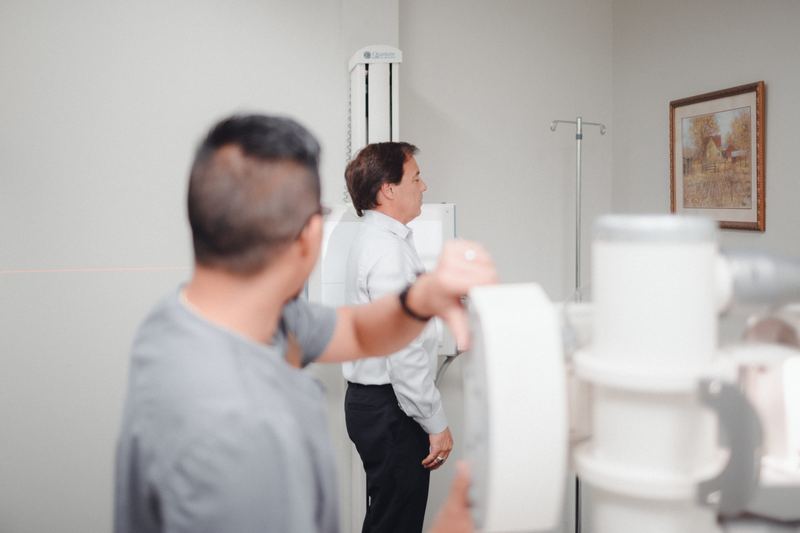
Digital X-Ray After a Car Accident in Oklahoma City
Digital X-ray is the fastest first look at your bones and alignment after a crash. At Accident Care, X-rays are on-site and are usually done the same day as your exam, so your physician can rule out fractures and instability before treatment starts.
- Usually same day
- About 10 minutes
- Very low dose
- ~10 minTypical X-ray series
- 0.1 mSvApproximate dose, chest X-ray
- 2+ viewsEvery body part, at right angles
- Same dayUsually done at your exam visit
Why X-rays still matter after a crash
What is an X-ray?
An X-ray (radiograph) passes a brief, low-dose beam of X-ray photons through the body onto a digital detector. Dense tissue such as bone absorbs more of the beam and appears white; air appears black. After a car accident, X-rays are the first-line test for fractures, dislocations, and spinal alignment, and flexion-extension views can reveal ligament-related instability. They do not show discs, ligaments, muscles, or nerves directly.
X-ray is quick, widely understood, and low dose. It answers the first safety questions after a crash: Is anything broken? Is the spine aligned? Is there instability that changes how you should be treated? It also documents your baseline: any arthritis or degenerative change present right after the accident is on record.
At Accident Care, X-rays are performed in our own facility and are usually done the same day as your physician exam. If the X-ray raises a question it can’t answer, your physician can order CT or MRI in the same building.
How an X-ray works
The X-ray tube produces a short burst of high-energy photons. The technologist sets the energy (kVp) and quantity (mAs) for the body part and your size, and collimates the beam to the area of interest.
Photons are absorbed (attenuated) in proportion to tissue density and atomic number. Radiographs show five basic densities: air (black), fat (dark gray), soft tissue and fluid (gray), bone (white), and metal (bright white).
A digital detector converts the photons that pass through into an image within seconds. Digital processing allows the radiologist to adjust contrast and magnify fine fracture lines.
An X-ray is a two-dimensional shadow of a three-dimensional body, so structures overlap. That is why every body part is imaged in at least two views at right angles; the radiology rule of thumb is “one view is no view.”
Common post-accident X-ray series
| Series | Standard views and purpose |
|---|---|
| Cervical spine | AP, lateral (must show the C7–T1 junction; a swimmer’s view is added if it doesn’t), and open-mouth odontoid view of C1–C2 |
| Flexion-extension (cervical or lumbar) | Lateral views with the neck or back bent forward and backward to look for abnormal motion between vertebrae; often deferred until acute muscle spasm settles |
| Thoracic and lumbar spine | AP and lateral, sometimes obliques, for compression fractures, alignment, and the pars interarticularis |
| Chest and ribs | PA/AP and lateral chest, with rib views for seatbelt and steering-wheel impact |
| Extremities | At least two views (AP and lateral, often an oblique) of the shoulder, wrist, hand, knee, ankle, or foot |
What X-rays show after a car accident
Fractures
Vertebral, rib, clavicle, wrist, hand, knee, ankle, and foot.
Displaced fractures are usually obvious. Subtle or non-displaced fractures may need CT or MRI, or a repeat X-ray in 10 to 14 days, when bone healing makes them visible.
Spinal alignment
The four contour lines of the lateral cervical spine.
Radiologists trace the anterior vertebral, posterior vertebral, spinolaminar, and posterior spinous lines. A step-off in any line suggests subluxation or ligament injury.
Instability
Abnormal motion on flexion-extension views.
Classic clinical criteria (White and Panjabi) treat more than 3.5 mm of horizontal translation or more than 11 degrees of angulation between adjacent cervical vertebrae as a sign of instability.
Prevertebral soft-tissue swelling
An indirect sign of injury in front of the spine.
A common adult rule of thumb is no more than about 7 mm at C2 and 22 mm at C6. Widening can signal hemorrhage or edema from an underlying injury.
Dislocation
Joint position in the shoulder, fingers, and spine.
X-ray confirms whether a joint is out of place and checks the result after it is reduced.
Baseline degeneration
Arthritis, disc space narrowing, and osteophytes.
Documenting pre-existing changes right after the crash helps your physician separate new injury from old wear and tear.
What “loss of lordosis” on your report does and doesn’t mean
Many post-accident neck X-ray reports mention straightening or loss of the normal cervical lordosis (the gentle forward curve of the neck). This can reflect protective muscle spasm after a whiplash injury, but it is also seen with positioning in the X-ray room and in a meaningful share of people with no symptoms. On its own it is not proof of injury, and your physician interprets it alongside your exam.
Of more concern are a focal kyphosis (a sharp angle at one level), a step-off in the alignment lines, widening of the space between spinous processes, or fanning of the facets, any of which can indicate ligament injury and may prompt flexion-extension views, CT, or MRI.
Hurt in a car accident? See a medical doctor. No outside imaging center, no upfront out-of-pocket cost.
What X-ray can and can’t do
Strengths
- Fast, widely available, and usually done the same day as your exam
- Low radiation dose for most studies
- Excellent for fractures, alignment, and dislocations
- Flexion-extension views show motion and instability
Limits
- Doesn’t show discs, ligaments, muscles, nerves, or the spinal cord
- Overlapping anatomy can hide fractures, especially in the spine, wrist, and ribs
- Some fractures aren’t visible for 10 to 14 days
- A normal X-ray doesn’t mean you weren’t injured
X-ray safety
- Doses are low: about 0.1 mSv for a chest X-ray, about 1.4 mSv for a lumbar spine series, and about 0.001 mSv for an extremity, compared with about 3 mSv of natural background radiation per year.
- Tell us if you are or may be pregnant. Shielding and protocol choices are adjusted, or an alternative test is considered.
- Remove jewelry, metal, and clothing with zippers or snaps from the area being imaged.
Step by step at Accident Care
- 1
Your physician examines you
X-rays are ordered based on your exam and the mechanism of your crash.
- 2
Same-day imaging, usually
X-rays are taken in our facility, usually at the same visit as your exam.
- 3
Positioning
The technologist positions you for each view. Flexion-extension views are only done if you can move safely.
- 4
Images in seconds
Each exposure takes a fraction of a second. A typical series takes about 10 minutes.
- 5
Radiologist read
A board-certified radiologist reviews the images and issues a written report.
- 6
Results and next steps
Your doctor reviews the report with you, usually at your next appointment, and orders CT or MRI if more detail is needed.
X-ray after a car accident: common questions
Will an X-ray show whiplash?
Not directly. Whiplash injures soft tissues such as muscles, ligaments, and facet joints, which X-rays don’t show. X-rays are used to rule out fractures and instability and to document alignment. MRI is used when a soft-tissue or disc injury is suspected.
Why do I need flexion-extension X-rays?
Bending views show how vertebrae move relative to each other. Abnormal sliding or angulation can indicate a ligament injury that standard views miss. They are usually done only when it is safe for you to move, and sometimes deferred until muscle spasm settles.
My X-ray was normal but I still hurt. Why?
Most car accident injuries are soft-tissue injuries that X-rays cannot see. Some small fractures also don’t appear until healing begins. A normal X-ray rules out major bony injury; it doesn’t rule out injury. Your physician may order MRI or CT if your symptoms suggest it.
How much radiation is in an X-ray?
Very little. A chest X-ray is about 0.1 mSv, roughly ten days of natural background radiation. A lumbar spine series is about 1.4 mSv. Extremity X-rays are even lower.
Can I get X-rays the same day as my appointment?
Usually, yes. X-rays are taken in our facility and are usually done the same day as your physician exam.
Does insurance cover X-rays after a car accident?
When another driver caused the accident, their insurance covers medically necessary imaging, including X-rays. Accident Care bills the insurance directly, so there is zero upfront out-of-pocket cost to you.
How long do X-rays take?
A typical series takes about 10 minutes. Each exposure lasts a fraction of a second; most of the time is spent positioning you for each view.
What X-rays are taken of the neck after a car accident?
A standard cervical spine series includes a front (AP) view, a side (lateral) view that must show down to the C7–T1 junction, and an open-mouth view of the top two vertebrae. Flexion-extension views may be added to check for instability.
Do I need X-rays if I feel fine after a crash?
Not always. Symptoms from car accident injuries are often delayed by hours or days, so a medical evaluation is still worthwhile. Your physician uses your exam and validated decision rules to decide whether imaging is needed.
Can X-rays show arthritis or old injuries?
Yes. X-rays show degenerative changes such as disc space narrowing, bone spurs, and old healed fractures. Documenting these right after a crash helps your physician distinguish new injuries from pre-existing conditions.
Can an X-ray miss a rib fracture?
Yes. Non-displaced rib fractures, especially near the cartilage, are often not visible on standard X-rays. If your exam strongly suggests a rib fracture, your physician may order CT.
Why do X-rays always include at least two views?
An X-ray is a flat shadow of a three-dimensional body, so a fracture can hide behind overlapping bone in one view. Imaging at right angles reveals what a single view misses.
Are X-rays safe if I might be pregnant?
Tell us before any X-ray. Most X-rays away from the abdomen deliver very little dose to a fetus, but your physician will adjust the approach or choose another test if needed.
Do I need a referral for X-rays at Accident Care?
No outside referral is needed. X-rays are ordered by your Accident Care physician and are usually done the same day as your exam.
Other diagnostic tools at Accident Care
MRI
How our on-site GE 1.5 Tesla wide-bore MRI finds disc herniations, ligament tears, bone bruises and nerve compression after a crash.
Learn moreCT scan
How our on-site Siemens SOMATOM go.Top 128-slice CT finds fractures and bony injuries after a crash.
Learn moreUltrasound
How our on-site Canon Aplio a550 ultrasound finds muscle, tendon, and ligament injuries after a crash, in real time and without radiation.
Learn moreFluoroscopy
How Accident Care uses two GE 9800 C-arm fluoroscopy systems for real-time spine and joint imaging and image-guided injections.
Learn moreNerve testing (EMG/NCV)
How EMG and nerve conduction velocity (NCV) studies diagnose pinched nerves, radiculopathy, and nerve injury after a crash: latency, amplitude, conduction velocity, denervation timing, and what to expect.
Learn moreFunctional & lab tests
How Accident Care measures injury objectively: range of motion in degrees, strength grading, reflexes, provocative tests, validated disability scores like the NDI and Oswestry, and targeted lab work.
Learn more
Sources and further reading
- White AA, Panjabi MM. Clinical Biomechanics of the Spine. 2nd ed. Lippincott, 1990.
- American College of Radiology. ACR Appropriateness Criteria: Suspected Spine Trauma; Acute Hand and Wrist Trauma.
- RadiologyInfo.org (ACR/RSNA). Radiation dose in X-ray and CT exams.
- Helliwell PS, et al. The straight cervical spine: does it indicate muscle spasm? Journal of Bone and Joint Surgery (British), 1994.
This page is educational and doesn’t replace an evaluation by a physician. Last reviewed November 2026. If you have severe headache, confusion, weakness, loss of bladder or bowel control, or chest or abdominal pain after a crash, call 911 or go to the nearest emergency room.
Get the answers you need, all in one place.
Same-day appointments available. Walk-ins welcome. No upfront out-of-pocket cost.